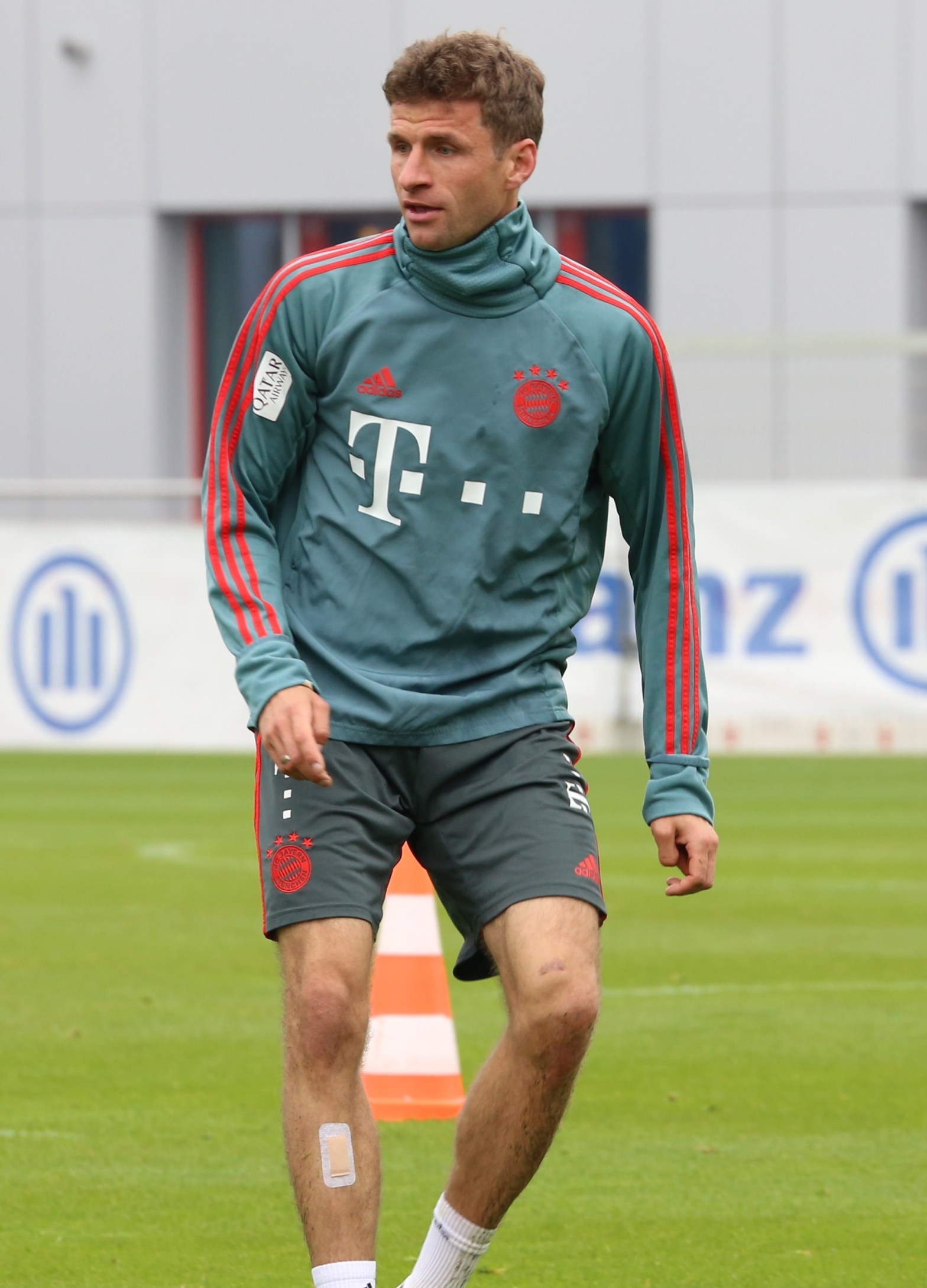
Watching Thomas Müller’s first 100 Bundesliga goals on YouTube, as I have just done, it is hard not to end the montage feeling more puzzled than before.
At least half of Müller’s strikes could generously be described as ugly – scuffed finishes, tap-ins (often as he falls over) or simply sidefoots into an empty net after an outstanding assist by a stellar team-mate like Arjen Robben or Robert Lewandowski. Such scruffiness might be normal for a traditional “fox in the box” striker, a Ruud van Nistelrooy or a Gary Lineker. But Müller is not an out-and-out goalscorer in this mould, nor especially prolific by Bayern Munich’s standards.
Ever since he burst, fully formed, onto international screens in the 2010 World Cup, overseas observers have scratched their heads over the Müller mystery. What makes him good? What does he even do on the pitch? Asked to identify the outstanding feature of his game, most of us would struggle. Müller would be little more than an afterthought among lists of the greatest players of the last decade. Yet in the era of Messi and Ronaldo, it is Müller – rather than either of those leading lights – who was top scorer at consecutive World Cups, and who won the tournament itself in 2014.
The seemingly ageless Müller emerged as a gangly, awkward forward perfectly suited to Germany’s playground-esque counter-attacks of the South Africa World Cup – a willing runner, always in the right place at the right time.
His first ever World Cup goal, against Australia, neatly highlights two of his outstanding traits. As Lukas Podolski collects the ball near halfway and begins to charge forward in his inimitable style, Müller’s awareness of the gap in the Socceroos’ defence appears almost genetically hard-wired, such is the purpose with which he drives towards it. The nonchalant manner in which, upon receiving possession, he easily turns his defender and takes all the time he needs to line up his shot, demonstrates his rare clear-headedness. If this combination of spatial understanding (Müller has referred to himself as a Raumdeuter, an “interpreter of space”) and composure are two fundamental components of his astonishingly successful career, the third is evident in his next World Cup goal.
With the second-round match against England unjustifiably tightly poised at 2-1 (Germany had battered Capello’s side for much of the preceding 66 minutes), Müller’s finish at the end of a thrilling three-man raid prompted a wildly exuberant and almost bizarrely old-fashioned celebration. While Müller’s mastery of the TV-era celebration doesn’t appear to have improved in the subsequent decade, his ferocious drive to win remains as formidable now as it was at the outset of his career. It was evident yet again in Bremen on Tuesday night, as Müller’s impassioned celebrations at the final whistle perhaps seemed surprising given that this was his 9th Bundesliga title – to sit alongside the 5 DFB Cups, World Cup and Champions League already on his CV.
Müller’s unconventional style and relative lack of technical brilliance (his compatriot Mario Götze, for example, has always been considered more gifted yet has had a much less successful career by any standards) mean that he has moved in and out of fashion during his career. Dropped from the Germany squad at the start of 2019, Müller has bounced back spectacularly this season – breaking the all-time record for Bundesliga assists just as many thought his star was beginning to wane. Still only 30 and now firmly back in favour in Bavaria, he’ll surely add many more ugly finishes to his montage before his playing time is up.
 Gegenpress